
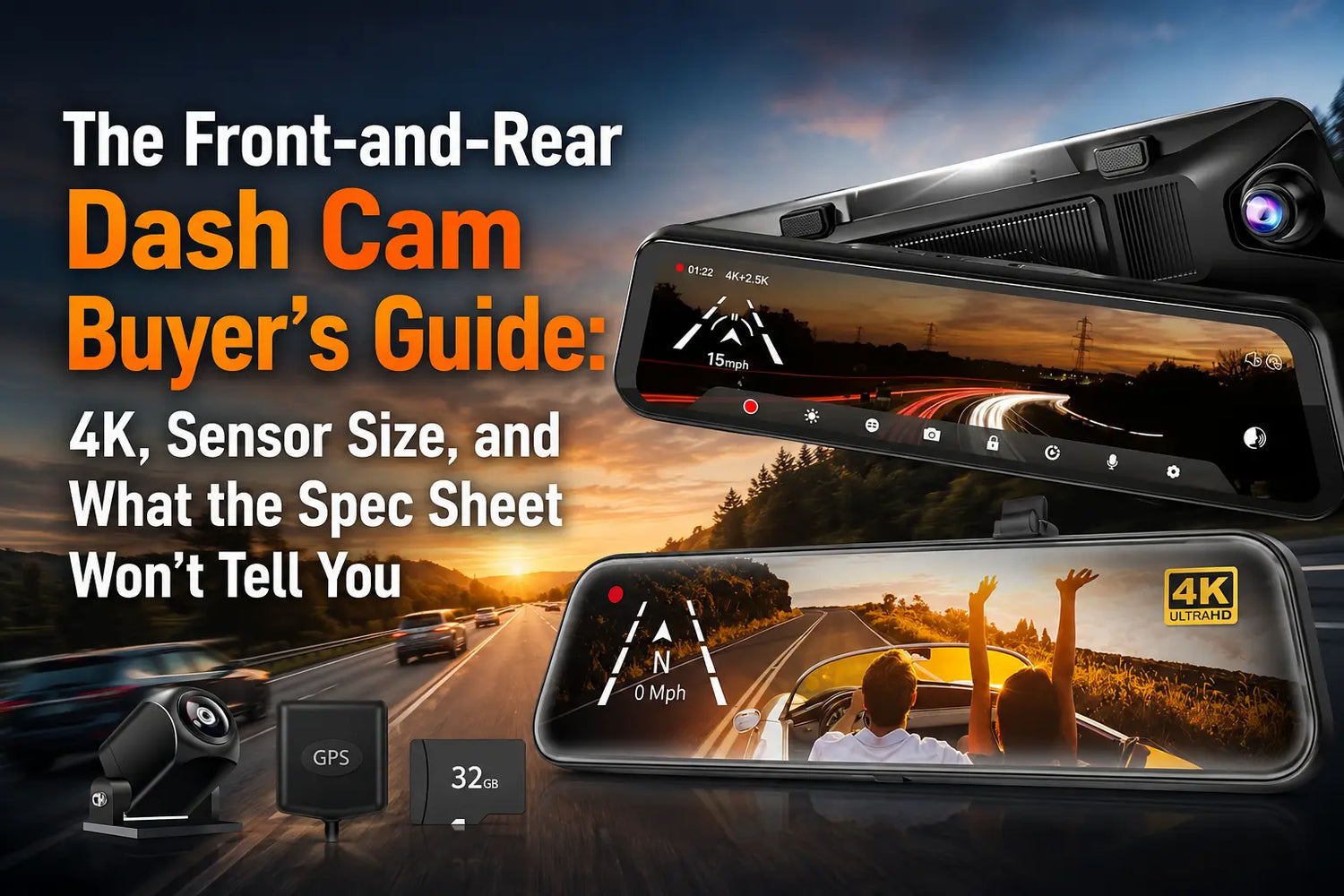
Most dash cam comparisons start and end with resolution. That's a mistake. Resolution determines the maximum detail a camera can theoretically capture. The image sensor determines how much it actually captures at night, in rain, or in the glare of oncoming headlights — which is when footage matters most. Two cameras can both say "4K" on the box while delivering footage that looks nothing alike in real-world conditions. This guide explains what to look for beyond the headline number, using concrete specs and real-use scenarios.
Sensor Size: The Number That Actually Determines Image Quality
The image sensor is the most important spec in any dash cam. It determines how much light the camera collects per frame, which directly affects night footage, rainy-day clarity, and plate readability at highway speed.
Pixel size, measured in micrometers (µm), is the key metric. Larger pixels gather more light. A sensor with 2.0 µm pixels gathers roughly twice as much light per pixel as a sensor with 1.4 µm pixels — a meaningful difference that shows up most clearly in low-light conditions. That gap shows up clearly in footage shot at 2 a.m. on an unlit road.1
Sensor |
Resolution |
Pixel Size |
Low-Light Rating |
Found In |
Sony IMX678 (STARVIS 2) |
4K / 8MP |
2.0 µm |
Excellent |
WOLFBOX G900 Pro (front), X5 Duo (front) |
|
Sony IMX675 (STARVIS 2) |
2.5K / 5MP |
2.0 µm |
Very Good |
X5 Duo (rear) |
Sony IMX335 |
approx. 5MP |
2.0 µm |
Good |
Various mid-tier dash cams |
Generic SC500AI |
5MP |
1.4 µm |
Fair |
Budget models |
The Sony IMX678 STARVIS 2 used in the WOLFBOX G900 Pro front camera uses back-side illuminated (BSI) architecture — the light-sensitive layer sits closer to the lens, capturing more photons per frame than conventional front-side illuminated designs. STARVIS 2 describes a specific Sony sensor architecture, not a brand name.1 2
Field of View: Wider Has a Real Trade-Off
Field of view (FoV) describes how much of the scene a camera captures horizontally. Most front-facing dash cams fall between 140° and 170°. Wider is not automatically better. The trade-off is geometric: wider angles compress the center of the frame, reducing the apparent size of vehicles directly ahead — including their license plates.
The WOLFBOX G900 Pro uses 130° front and 150° rear.2 At 130°, the front camera sits at the narrower end of the typical 140°–170° dash cam range, trading peripheral width for sharper center-frame detail — which translates to better plate readability at highway distances. Drivers who prioritize maximum side coverage in dense urban or rideshare environments may prefer a wider-angle option. There is no universally correct FoV.
Front FoV |
Rear FoV |
Plate Readability (approx.) |
Best Use Case |
140° |
140° |
Strong at ~40 ft |
City driving, tight lanes |
150° |
150° |
Good at ~35 ft |
Highway and city balance |
170° |
150° |
Moderate center detail |
Maximum side coverage, rideshare |
4K Front + 2.5K Rear: What This Resolution Pair Delivers
For most buyers in 2026, the practical ceiling for a dual-channel system is 4K (3840×2160) front and 2.5K (2560×1440) rear. 4K front provides enough detail to read plates at highway speed in daylight. 2.5K rear is a step up from 1080P in low-light without doubling storage consumption. The WOLFBOX G900 Pro records 4K at 30 fps front and 2.5K at 30 fps rear simultaneously, and supports microSD cards up to 512 GB.2
TechRadar reviewed the G900 Pro and described the video quality as "excellent — among the best I've seen from any dash cam to date," with specific mention of the front camera's performance in mixed lighting conditions.1
Resolution |
File Size per Hour |
128 GB Holds (Approx.) |
4K 30 fps (front) |
6–8 GB/hr |
16–21 hours |
2.5K 30 fps (rear) |
3–4 GB/hr |
32–43 hours |
1080P 30 fps |
1.5–2 GB/hr |
64–85 hours |
Dual 4K + 2.5K combined |
9–12 GB/hr |
10–14 hours combined |
The G840S: 4K Front, 1080P Rear, and the Display Difference
The WOLFBOX G840S provides 4K UHD front recording and 1080P rear on a 12-inch IPS touchscreen that replaces the rearview mirror.4 Car and Driver named it a top overall pick in their 2026 Best Backup Cameras evaluation.5 The value case is primarily the display: instead of a small OEM backup camera screen mounted elsewhere, the mirror itself becomes a 12-inch view of what's behind you when reversing.
The real trade-off versus the G900 Pro is rear camera quality: 1080P versus 2.5K, and no STARVIS 2 rear sensor. For buyers who prioritize the display experience and primarily need strong front recording for insurance documentation, the G840S is the right choice at a lower price. For buyers who want the strongest rear footage alongside 4K front, the G900 Pro is the upgrade.
Parking Mode: What It Requires That Most Reviews Skip
Parking mode lets the dash cam record when the ignition is off, triggered by motion or G-sensor impact. This requires a hardwire kit — a separate accessory that draws low-level power from the vehicle's fuse box. Without it, the camera powers off with the ignition. The hardwire kit includes a voltage cutoff to prevent battery drain below the threshold needed to start the car.7 Any description of parking mode as a default built-in feature is incomplete without noting this.
Which WOLFBOX Model Fits Your Situation?
Your Priority |
Best Model |
Why |
4K + 2.5K, GPS, insurance documentation |
G900 Pro |
Sony IMX678 front + OmniVision OS04J10 rear, 4K + 2.5K, GPS, supports up to 512 GB microSD2 |
Mirror display + 4K front + backup cam view |
G840S |
12-inch IPS display, 4K front, GPS, proven value5 |
Front + rear + interior (rideshare) |
G900TriPro Cabin |
3-channel: front, rear, and interior simultaneously3 |
Front + rear + bumper exterior |
G900TriPro Bumper |
3-channel: front, rear, and bumper-mounted exterior3 |
Top sensor in compact windshield format |
X5 Duo |
Sony IMX678 front + IMX675 rear, 4K + 2.5K, no mirror format8 |
Frequently Asked Questions
Q: What is the difference between 4K and 2.5K in a front-and-rear dash cam?
A: 4K (3840×2160) has approximately 125% more pixels than 2.5K (2560×1440). The difference is most visible when reading license plates at distance in daylight. For rear cameras, 2.5K is a meaningful step up from 1080P in low-light. Combined storage for a 4K front + 2.5K rear system runs approximately 9–12 GB per hour.
Q: Does a wider field of view always mean better dash cam coverage?
A: No. Wider angles (160–170°) capture more peripheral scene but compress the center of the frame, making vehicles directly ahead appear smaller. For highway driving where plate capture at distance matters, 140–150° front can outperform 170°. The right FoV depends on your primary driving environment.
Q: What is the Sony IMX678 STARVIS 2 sensor and why does it matter?
A: The Sony IMX678 is a back-side illuminated CMOS sensor with 2.0 µm pixels. STARVIS 2 refers to Sony's second-generation BSI design, which repositions photodiodes closer to the lens for higher light capture per frame. Compared to budget sensors with 1.4 µm pixels, the IMX678 gathers roughly twice as much light — which is why low-light footage from cameras using it looks noticeably cleaner.
Q: What SD card should I use with a 4K dash cam?
A: Use a microSD rated Class 10 / U3 / V30 minimum. Below U3, cards may drop frames during 4K continuous recording. High-endurance cards rated for 1,000+ write cycles are recommended for loop-recording use where the card is written and overwritten continuously.
Q: Does the WOLFBOX G840S include GPS?
A: Yes. The G840S includes GPS that embeds speed and location data into recorded footage. This data is accessible through the WOLFBOX GPS Player and is useful for insurance claims and dispute resolution.
Q: What does G-sensor event locking do?
A: The G-sensor detects sudden deceleration or impact. When triggered, it saves and write-protects the current recording clip so loop recording cannot overwrite it. This preserves collision footage automatically, even if you don't manually save it at the time.
Q: Is the G900 Pro better than the G840S for night driving?
A: For rear camera night footage specifically, yes. The G900 Pro uses an OmniVision OS04J10 rear sensor versus the G840S's 1080P rear. The G900 Pro's front IMX678 is also the stronger sensor. If night footage quality front and rear is the top priority, the G900 Pro is the better choice. For buyers who want a capable mirror dash cam at a more accessible price point, the G840S remains the right pick.
References
1. TechRadar – Wolfbox G900 Pro Dash Cam Review: https://www.techradar.com/vehicle-tech/dash-cams/wolfbox-g900-pro-dash-cam-review
2. WOLFBOX G900 Pro Official Product Page: https://wolfbox.com/products/wolfbox-2024-g900-pro-wifi-touch-screen-parking-monitoring-dash-cam-smart-mirror-with-starvis-678-sensor
3. AutoGuide – Wolfbox G900TriPro Dash Cam Review: https://www.autoguide.com/auto/wolfbox-g900-tripro-dash-cam-review-44623066
4. WOLFBOX G840S Official Product Page: https://wolfbox.com/products/wolfbox-g840s-12-4k-mirror-dash-cam-2160p-full-hd-smart-rear-view-camera-mirror-dash-cam
5. Car and Driver – Best Backup Cameras of 2026, Tested: https://www.caranddriver.com/car-accessories/g44411856/best-backup-cameras-tested/
6. Road and Track – Best Dash-Cam Deals for Prime Day 2026: https://www.roadandtrack.com/gear/g71482999/dash-cam-deals-prime-day-2026/
7. WOLFBOX Blog – Best Parking Mode Dash Cams: https://wolfbox.com/blogs/dash-cams/best-parking-mode-dash-cams
8. WOLFBOX X5 Duo Official Product Page: https://wolfbox.com/products/wolfbox-x5-duo-4k-2-5k-starvis-2-imx678-front-and-rear-mini-dash-cam
9. WOLFBOX Official Blog – Which Dashcams Have the Best Video Quality: https://wolfbox.com/blogs/news/which-dashcams-have-the-best-video-quality
10. WOLFBOX About Us: https://wolfbox.com/pages/about-us

Leave a comment
All comments are moderated before being published.
This site is protected by hCaptcha and the hCaptcha Privacy Policy and Terms of Service apply.