
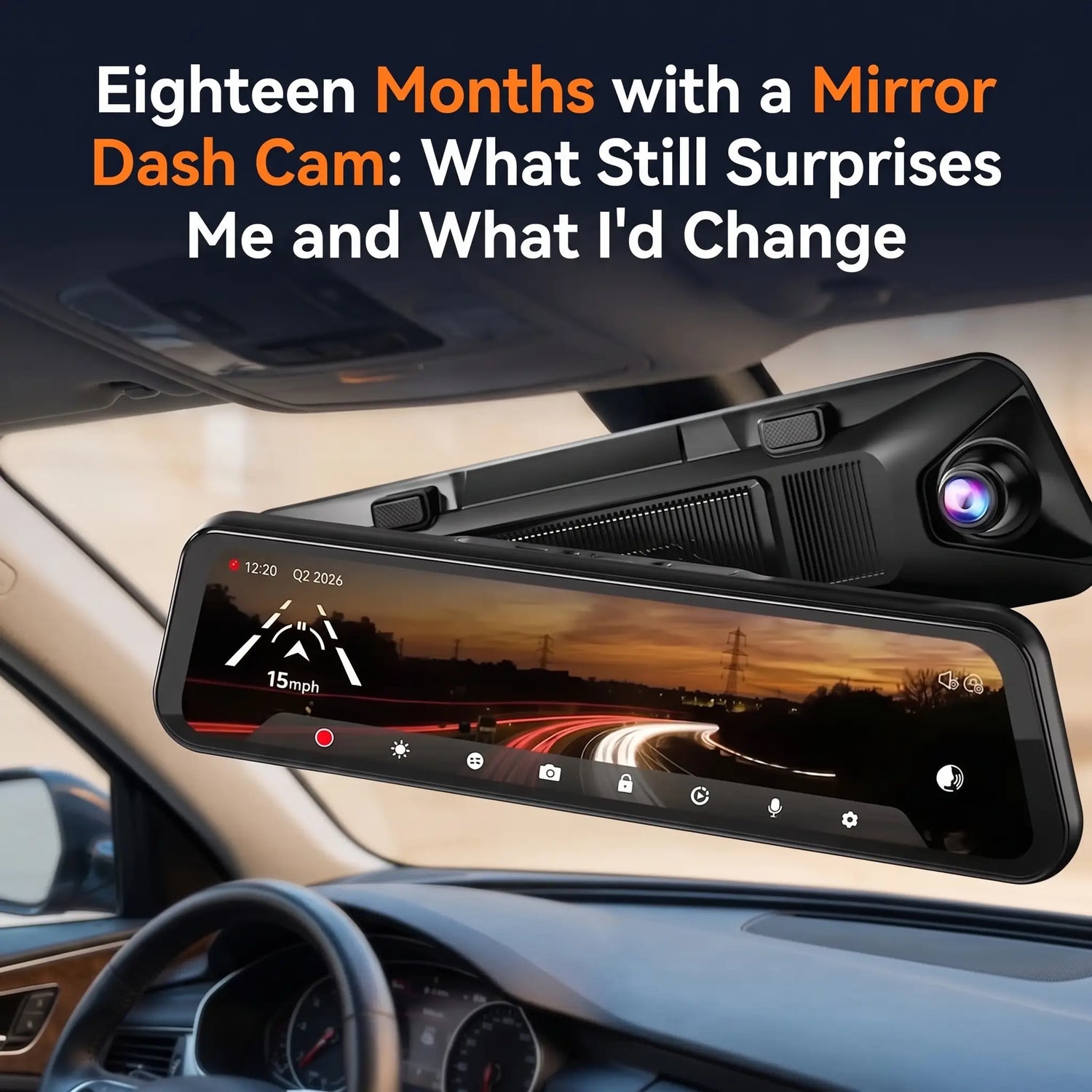
Installation day was a Saturday in December 2024. I spent about three hours routing a 20-foot rear camera cable along the headliner of a mid-size SUV — prying the A-pillar trim with a plastic tool, feeding the cable through the weatherstrip, clipping it tight against the headliner fabric. By the time it was done, nothing was visible. The camera sat flush behind the factory mirror position. The 12-inch display came on when I started the car, showing a split-screen rear view wider than I'd ever seen in a rearview mirror.
That was eighteen months ago. Here's what actually happened.
The First Two Weeks
The adjustment period that reviewers mention is real, and worth taking seriously before dismissing it.
A traditional optical mirror reflects a narrow horizontal band — roughly 20° of what's directly behind the car. The rear camera on the G900 Pro covers a significantly wider field of view [1][5]. More of the road is visible, but the way you read depth and proximity in a digital image is different from a reflected one. The first several days, I misjudged available space when parallel parking and braked a beat late for cars slowing behind me.
This resolved. By day ten I had stopped thinking about it. By the end of the first month, looking at the optical mirror in a rental car felt narrow in a way I hadn't noticed before.
If the depth perception adjustment is your main concern before buying: it's real, it takes approximately two weeks of daily driving, and virtually everyone who gets past that window keeps the camera.
The Event That Validated the Purchase
In April, I came back to a scraped rear bumper in a parking garage. No note. The garage's security camera was mounted too far away to capture plate detail.
The dash cam had parking mode enabled via hardwire kit [7]. The G-sensor had triggered on impact and locked the clip. The footage showed a silver sedan reversing out of the adjacent space, making contact with my rear quarter, pausing briefly, and driving away. The license plate was fully legible.
I filed an insurance claim that afternoon with the clip attached. The adjuster didn't ask follow-up questions. Total time from incident to claim filed: about two hours.
This was not a dramatic moment. It was a parking lot. But it's exactly the scenario that anyone who's returned to a damaged car with no trace of the other driver would recognize. The footage exists because of a 45-minute installation task done in December. Without the hardwire kit, the camera powers down when the engine is off. Without parking mode, there is no footage of anything that happens while you're away.

What Didn't Hold Up the Way I Expected
Screen brightness in direct afternoon sun. Driving westbound in June and July around 5–6 PM, the rear display washes out enough that I defaulted to the optical side mirrors for reference during that window. Not a safety issue — the side mirrors covered it — but the digital rear view, which is otherwise better than an optical mirror in almost every condition, becomes worse in one specific lighting scenario.
This is physics. LCD screens have a maximum output brightness [4]. Glass reflects regardless of ambient light levels. Reviewers who don't mention this are not being fully honest about the product.
The SD card failed at fourteen months. The original card started producing occasional read errors during footage review — clips would begin playback and stutter. This is expected behavior for standard-grade microSD cards under continuous write load. I replaced it with a Samsung PRO Endurance card rated for sustained recording, and the errors stopped [6]. The original card lasted longer than some dash cam users report; the ending was the same.
What Held Up Better Than Expected
The mounting hardware [2][3]. After eighteen months of daily driving — highway miles, a few hundred miles of gravel, one winter of Chicago-area freeze-thaw cycles — nothing has loosened. The rubber strap mount on the mirror has not shifted. The cable clips along the headliner have not pulled free. I checked before writing this and everything is exactly where I left it in December 2024.
GPS accuracy remained consistent throughout. The parking garage clip had precise coordinates and a timestamp accurate to the second. Footage with GPS corroboration is significantly harder to challenge than footage without it.
Night recording quality held steady from day one to month eighteen. The Sony STARVIS 2 sensor captures light through hardware sensitivity rather than software amplification, which is why the quality is consistent rather than drifting over time.

What I'd Do Differently
Hardwire from day one, not three weeks later. I delayed the kit installation, which meant three weeks of parking vulnerability before the camera was fully operational. The installation takes about 45 minutes. Do it the same day.
Use a high-endurance SD card from the first day. Not because the included card is bad — it worked for over a year — but because the failure mode is wrong. A card that dies in silent read errors while appearing to record normally is worse than a card that fails loudly. The cost difference is approximately $20–25.
Spot-check footage once a month. Pull one clip and confirm it plays cleanly. Two minutes of verification every 30 days eliminates the risk of discovering, at the moment footage matters, that the camera has been recording corrupt files for weeks.
Eighteen months later: I would buy it again. I would change the setup workflow, not the product.
Frequently Asked Questions
Q: How long does the depth perception adjustment actually take?
About two weeks of daily driving. After that, the wider digital rear view typically feels more natural than the narrow field of a traditional optical mirror.
Q: Is the hardwire kit necessary, or can I run it from the cigarette lighter?
For parking mode — recording while the engine is off — the hardwire kit is required. A cigarette lighter connection cuts power when the engine is off and records nothing while the car is parked.
Q: What SD card should I use to avoid the read-error failure at 14 months?
A high-endurance card rated for continuous recording: Samsung PRO Endurance, SanDisk High Endurance, or Kingston High Endurance.
Q: Is the screen brightness problem in direct sun a big deal?
It depends on your commute direction and time of day. In most conditions the display is excellent. In direct low-angle afternoon sun it washes out. Optical side mirrors cover that window. It is a real limitation worth knowing about before purchase.
Q: Does parking mode drain the car battery?
The hardwire kit includes a low-voltage cutoff that stops power draw before the battery drops to an unsafe level (typically set to 11.8V or 12V). Under normal conditions, parking mode overnight does not drain a healthy battery to a point that prevents starting.
References
[1] Wolfbox dash cam collection — mirror dash cam product overview and parking mode context: https://wolfbox.com/collections/dash-cam
[2] Wolfbox G840S official product page — supercapacitor design, GPS, and rear-camera installation context: https://wolfbox.com/products/wolfbox-g840s-12-4k-mirror-dash-cam-2160p-full-hd-smart-rear-view-camera-mirror-dash-cam
[3] Wolfbox G900TriPro Cabin official product page — mirror display, multi-channel recording, and supercapacitor hardware context: https://wolfbox.com/products/wolfbox-g900tripro-cabin-version-3-channel-dash-camera
[4] Car and Driver — Best Dash Cams for 2026: https://www.caranddriver.com/car-accessories/g46063800/best-dash-cams-tested/
[5] Electronic Imaging Symposium — Digital rear-view mirrors vs. traditional rear-view mirrors: https://library.imaging.org/admin/apis/public/api/ist/website/downloadArticle/ei/36/11/HVEI-215
[6] Wolfbox — Best Dash Cam for Road Trips, Truckers & Uber Drivers in 2026: https://wolfbox.com/blogs/dash-cams/best-dash-cam-for-road-trips-truckers-amp-uber-drivers-in-2026
[7] Wolfbox official hardwire kit and parking-mode accessory guidance: https://wolfbox.com/collections/accessories



Leave a comment
All comments are moderated before being published.
This site is protected by hCaptcha and the hCaptcha Privacy Policy and Terms of Service apply.