
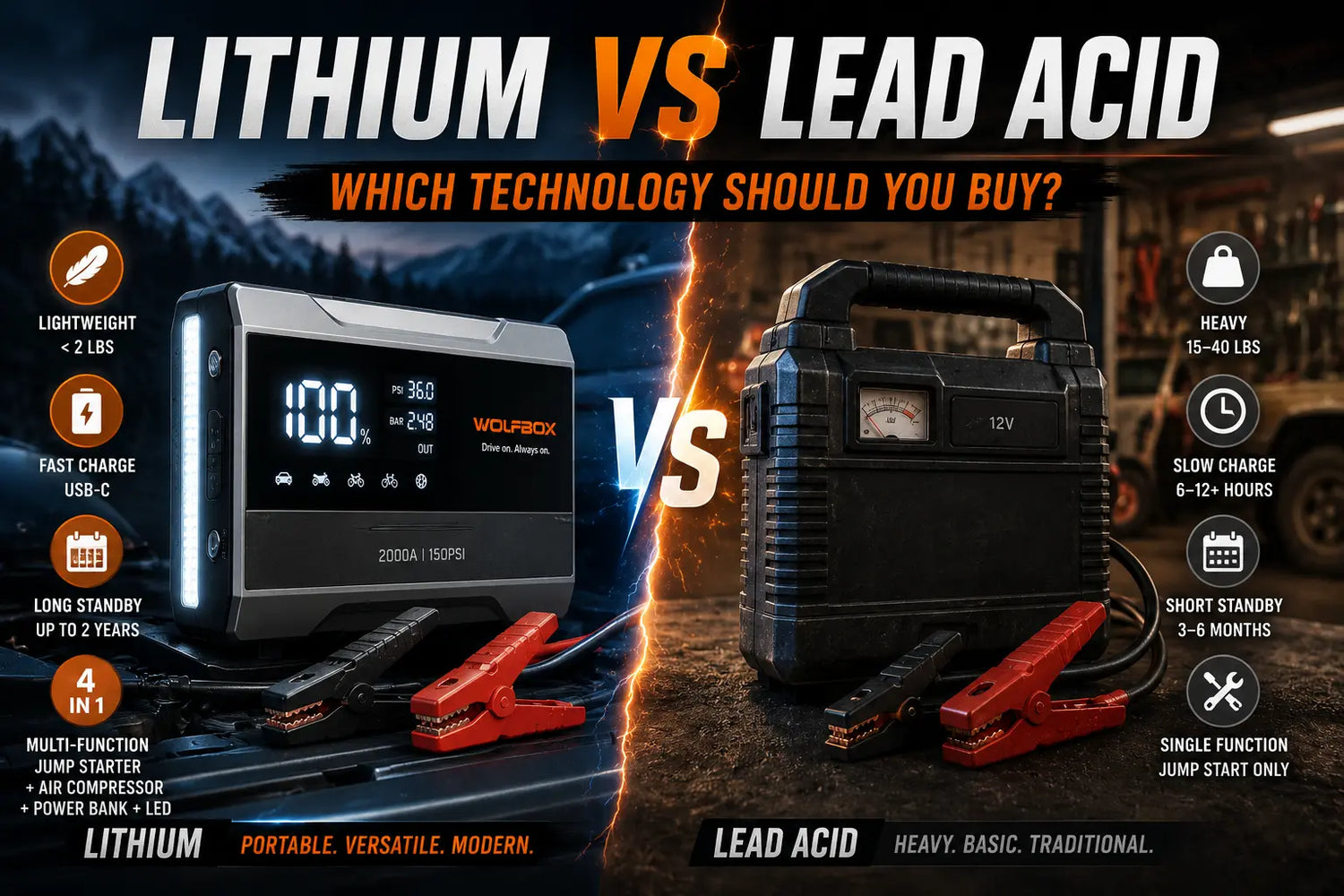
Walk into any auto parts store and you'll see two types of portable jump starters: compact lithium units that fit in a glove box, and heavy lead-acid packs the size of a lunch box. Both claim to jump-start your dead battery. The technology behind them is fundamentally different — and that difference determines which one belongs in your car. Impact Battery's technical guide confirms that "lithium-ion jump starters have more advantages than their lead-acid counterparts" for the vast majority of drivers.[5] A 2026 market trend report found that lithium-driven, multi-function jump starters now represent the fastest-growing segment of the portable jump starter market, with consumers increasingly viewing them as "high-power power banks."[6]
How Each Technology Works
A lithium jump starter uses lithium-ion cells — the same battery chemistry in smartphones and electric vehicles. The key advantage is energy density: lithium packs enormous starting current into a very small, lightweight package.
A lead-acid jump starter uses a sealed lead-acid battery — the same chemistry as a standard car battery, in a portable casing. Lead-acid packs are larger and heavier, but have a longer track record in extreme cold and heavy commercial applications.
Lithium vs Lead Acid: Direct Comparison
|
Factor
|
Lithium Jump Starter
|
Lead-Acid Jump Starter
|
|
Weight
|
Under 2 lbs (typical)
|
15–40 lbs
|
|
Size
|
Fits in glove box
|
Requires separate carrying case
|
|
Peak amps
|
400A–4,000A
|
850A–4,000A
|
|
Cold weather
|
Reduced below -4°F (-20°C)
|
Better below -20°F
|
|
Charge retention
|
Up to 2 years standby
|
3–6 months before needing recharge
|
|
Charge speed
|
1–3 hours via USB-C
|
6–12+ hours via wall charger
|
|
Extra functions
|
Air compressor, USB power bank, LED light
|
Jump start only (typical)
|
|
Safety
|
Reverse polarity, short circuit, over-voltage
|
Basic clamp protection
|
Impact Battery notes: "The weight savings compared to a comparable lead-acid jump starter can be as high as 70%."[5]
Weight & Portability
For the vast majority of drivers, portability wins. The Wolfbox MegaVolt 10Air weighs under 2 lbs and fits in a glove compartment.[1] A traditional lead-acid jump starter can weigh 15–40 lbs and requires trunk storage. Impact Battery confirms: "Some of the smaller lithium jump starters can fit in your pocket!"[5]
Cold Weather Performance
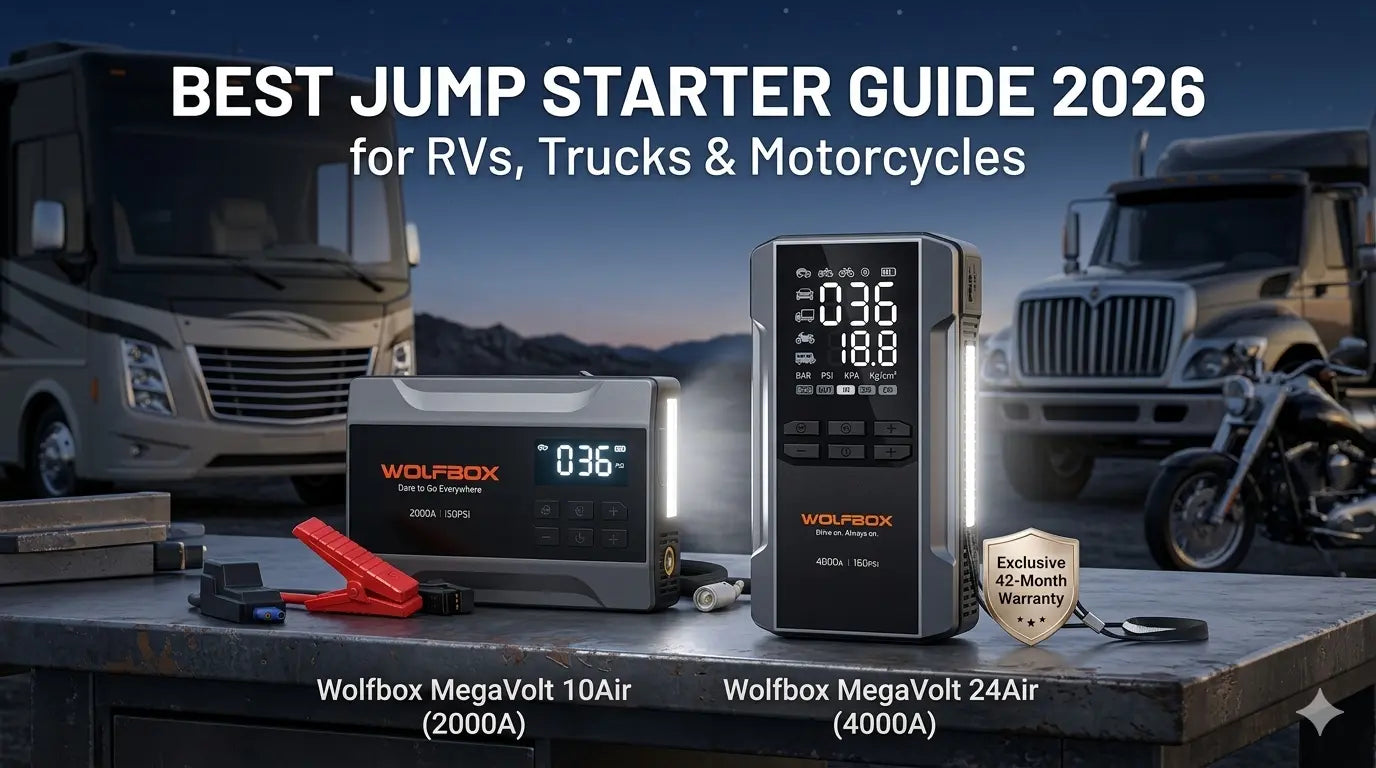
At temperatures below -20°F (-29°C), lead-acid maintains more consistent starting current than lithium. For most North American and European drivers, this distinction rarely matters in practice. The Wolfbox MegaVolt 10Air is rated to operate down to -4°F (-20°C)[1] — covering the vast majority of cold-weather scenarios. For genuine extreme cold, the Wolfbox MegaVolt 24Air (4,000A) provides additional headroom and was tested and reviewed by Popular Science.[3]
Practical tip: Store your lithium jump starter inside your vehicle's cabin, not in the trunk, in sub-zero temperatures. Lithium batteries retain more capacity at cabin temperature.[1]

Multi-Function Capabilities
Modern lithium jump starters have evolved far beyond jump starting. The Wolfbox MegaVolt 10Air combines four functions:[1]
- 2,000A peak jump starter — handles gasoline engines up to 5.0L and diesel up to 2.5L
- 150 PSI air compressor — inflates a car tire from 29 to 36 PSI in approximately 1 minute
- 15W USB-C / 12W USB-A power bank — charges phones and tablets
- 200-lumen LED flashlight — normal, strobe, and SOS modes
Impact Battery concludes: "The best jump starter must be one with a built-in air compressor."[5] The Wolfbox MegaVolt 24Air (4,000A) was reviewed by Popular Science in February 2026, who described it as a device that "earns its spot in any car emergency kit with multiple functions, most of which come in handy during a crisis."[3] Pro Tool Reviews called the MegaVolt 24Air "suited for 12V vehicles like cars, trucks, and boats" with both Normal and Boost Start modes for flat batteries.[4]
Charge Retention
Lead-acid batteries self-discharge faster than lithium. A lead-acid jump starter stored in your trunk for 6 months may not have enough charge to start your car. Impact Battery confirms: "A lead-acid based jumper can lose its ability to function after 3–6 months in storage. Lithium jump starters can be viable up to two years later."[5]
Peak Amps: What Do You Actually Need?
- 800A–1,200A: Adequate for most compact cars and small sedans (4-cylinder engines)
- 1,500A–2,000A: Covers full-size gasoline trucks, SUVs up to 5.0L, and small diesel engines
- 3,000A–4,000A: Required for large diesel trucks, commercial vehicles, and Class A RVs
The Wolfbox MegaVolt 10Air (2,000A) handles gasoline engines up to 5.0L and diesel up to 2.5L.[1] The Wolfbox MegaVolt 24Air (4,000A) covers up to 10L diesel engines and was tested in real-world conditions by Pro Tool Reviews and Popular Science.[3][4] Car and Driver's 2026 jump starter test provides further context for peak amp requirements across vehicle classes.[7]

Note: "Peak amps" is the instantaneous maximum the unit can deliver. For hard starts, sustained cranking ability matters more. Always verify engine displacement compatibility for your specific vehicle.
Which Should You Buy?
Choose lithium if:
-
You want a unit that fits in your glove box or bag
-
You drive a standard gasoline or light diesel vehicle
-
You want USB power bank and air compressor multi-function capability
-
You operate in temperatures above -4°F (-20°C)
-
You want faster USB-C charging
Choose lead-acid if:
-
You operate commercial vehicles in extreme sub-zero environments regularly
-
You need sustained heavy-duty cranking on large diesel engines repeatedly
-
Portability is not a concern
For the overwhelming majority of drivers — passenger cars, SUVs, trucks, motorcycles, and RVs — a lithium jump starter is the better choice. Market data confirms lithium now represents the dominant and fastest-growing share of the portable jump starter market.[6]
Frequently Asked Questions
Q: Is lithium or lead acid better for a jump starter?
A: Lithium is better for most drivers. Lithium jump starters weigh under 2 lbs (vs. 15–40 lbs for lead-acid), charge faster via USB-C, retain charge for up to 2 years, and include multi-function capabilities. Impact Battery confirms lithium has "more advantages than their lead-acid counterparts."[5]
Q: What is the best lithium jump starter for an SUV?
A: The Wolfbox MegaVolt 10Air (2,000A) handles gasoline SUVs up to 5.0L with up to 30 jump starts per charge. Built-in 150 PSI air compressor, IP64 rating, 24-month warranty.[1]
Q: How does a jump starter work?
A: A jump starter is a high-output battery pack with intelligent clamps. Connect the red clamp to the positive (+) battery terminal and the black clamp to a metal engine block ground. The unit delivers instant cranking current to supplement the dead battery — no second vehicle needed.[1] Pro Tool Reviews describes both Normal Start and Boost Start modes for flat batteries.[4]
Q: What is the best jump starter under $150?
A: The Wolfbox MegaVolt 10Air — 2,000A peak, 150 PSI compressor, 15W USB-C, 200-lumen LED, IP64, 24-month warranty, all under $100. Popular Science reviewed the larger MegaVolt 24Air sibling and described the product family as earning "its spot in any car emergency kit."[3]
Q: Is 1000A enough for a jump starter?
A: 1,000A is sufficient for most 4-cylinder and 6-cylinder gasoline engines. For 5.0L+ engines, cold starts, or diesel, 2,000A provides better reliability. Car and Driver's 2026 jump starter testing provides vehicle-by-vehicle guidance.[7]
Q: What is the best jump starter Reddit recommends?
A: The Wolfbox MegaVolt 10Air appears consistently in automotive Reddit communities as a top pick for its 2,000A output, integrated air compressor, 24-month warranty, and under-$100 price. Impact Battery independently confirms the preference for lithium units with built-in air compressors.[5]
References
[1] Wolfbox MegaVolt 10Air Official Product Page — https://wolfbox.com/products/wolfbox-2000a-jump-starter-with-air-compressor-wolfbox-megavolt-10air
[2] Wolfbox MegaVolt 24Air Official Product Page — https://wolfbox.com/products/jump-starter-with-air-compressor-tire-inflator-wolfbox-megavolt-24air
[3] Popular Science — Wolfbox 4-in-1 Jump Starter with Air Compressor Review — https://www.popsci.com/gear/wolfbox-4-in-1-jump-starter-with-air-compressor-review/
[4] Pro Tool Reviews — Wolfbox MegaVolt 24 Jump Starter Review — https://www.protoolreviews.com/wolfbox-megavolt-24-jumpstarter-review/
[5] Impact Battery — Are Lithium Jump Starters Better Than Lead Acid? — https://www.impactbattery.com/blog/post/are-lithium-jump-starters-better-than-lead-acid
[6] GEHOPOW — Portable Car Jump Starter Industry Trend 2026 — https://gehopow.com/portable-car-jump-starter-industry-trend-2026/
[7] Car and Driver — Best Portable Jump Starters for 2026, Tested — https://www.caranddriver.com/car-accessories/g42569313/best-jump-starters-tested/


Leave a comment
All comments are moderated before being published.
This site is protected by hCaptcha and the hCaptcha Privacy Policy and Terms of Service apply.