






Your motorcycle battery isn't a car battery. Treating it like one is where most riders get it wrong about jump-starting. The best jump starter for a motorcycle isn't necessarily the most powerful one. It's the one that respects how small and sensitive a bike, scooter, or ATV battery actually is.
A typical car battery holds 40 to 60 amp-hours; a motorcycle battery often holds 4 to 12. That massive gap is why riders ask whether a "big" jump starter will hurt a small battery. The answer matters more than most product listings let on.
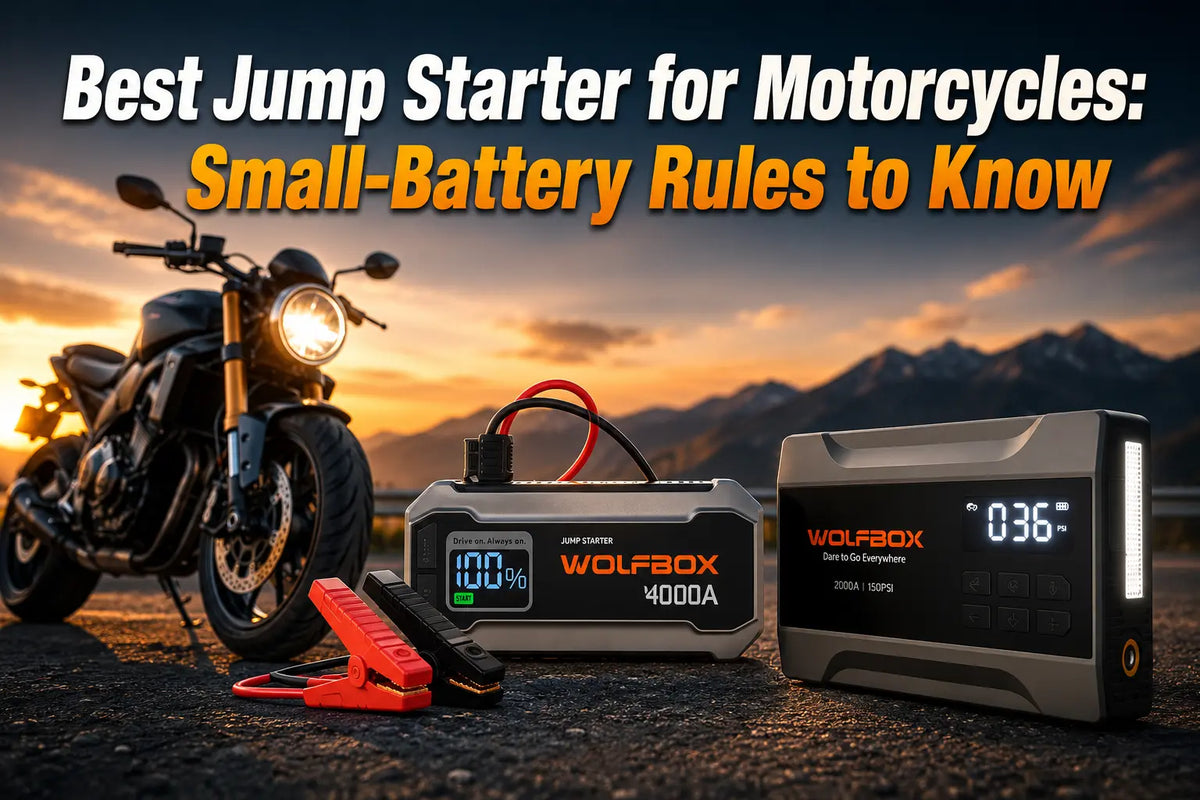
This guide covers the small-battery rules, clears up the biggest myth around peak amps, and compares two Wolfbox options. We'll discuss the compact MegaVolt 10Air and the higher-capacity MegaVolt 24. Both won't let you down on that one morning your battery does.
Best Jump Starter for Motorcycles: The Quick Answer
A portable lithium jump starter is a safe, reliable way to start a motorcycle, scooter, or ATV. The jump starter must be a high-quality unit with built-in current regulation that follows the same 12V-to-12V standard.
You'll also need to follow the correct polarity rules that apply to any vehicle. Some solo riders want something that tucks into a saddlebag. That's where the Wolfbox MegaVolt 10Air fits the bill. [1] [2]
Some riders have a truck or larger vehicle in the garage. The Wolfbox MegaVolt 24 covers both without two separate devices. [3] [4] That's the short version, as the sections below explain why size and regulation are more important than numbers.
What Makes a Jump Starter "Motorcycle-Safe"
Several features define a genuine bike-friendly jump starter. None of those are exotic, but they're easy to overlook if you're comparing units purely by peak amp rating. [5]
- Smart current regulation, so the unit only delivers the amperage the battery draws, not its full peak rating all at once.
- Reverse-polarity protection, which prevents damage if the clamps get connected backward in a rush.
- A compact, lightweight body that actually fits under a seat or in a saddlebag, not just a glove box.
- Clear connection indicators, since fumbling with motorcycle battery terminals is harder than reaching into a car engine bay.
WOLFBOX Jump Starters for Motorcycles: At A Glance
Both options below share the same safety fundamentals, but they're built for slightly different riders.
- The Wolfbox MegaVolt 10Air is the more compact option. It comes with a 2000A peak current, a 37Wh battery, and a size built for easy storage on a bike.
- The Wolfbox MegaVolt 24 offers 4000A peak current and a 24,000 mAh battery. It offers enough headroom to cover a truck, SUV, or diesel vehicle in the same household.
Both include reverse-polarity protection and multiple built-in safety features. The superior design can prevent a bad connection from becoming a bad day.
Why Motorcycle Batteries Play by Different Rules
A motorcycle battery is a fraction of the size of a car battery, both in physical capacity and in how much current it needs to crank an engine. Yuasa confirms that you can jump-start motorcycle batteries from another motorcycle, a car battery, or a portable jump starter. [6]
How Small a Motorcycle Battery Is
The numbers explain why riders are right to be a little more careful than car owners. It doesn't mean jump-starting a bike is fragile or risky when done correctly.
- A standard motorcycle battery holds roughly 4 to 12 amp-hours, compared to 40 to 60 amp-hours for a typical car battery.
- Most motorcycle starter motors only need about 150 to 300 Cold Cranking Amps to turn over, far less than a car's V6 or V8 engine.
- The starting demand is much smaller. So, the current draw during a jump start is nowhere near a jump starter's full peak rating.
The Voltage Rule You Can't Skip
Amperage aside, voltage compatibility is the one rule that has zero flexibility. Unlike amperage, no amount of built-in circuitry can safely correct a voltage mismatch.
- Most modern motorcycles run a 12V system, like cars, which is why a 12V jump starter works for both.
- Some older or smaller vintage bikes and mopeds use 6V systems, and connecting a 12V source to a 6V battery can cause real damage.
- Always confirm your bike's voltage from the manual or the battery label before connecting any jump starter.
Busting the "Too Many Amps Will Fry My Battery" Myth
A quality portable jump starter doesn't force its full peak amp rating into whatever it's connected to. Instead, it delivers only the current the battery and starter motor actually draw.
The bigger risk isn't a modern lithium jump starter with smart protection circuitry. It's all about jump-starting from a running car, where an unregulated alternator can push a voltage spike. [5]
Why a Smart Jump Starter Won't Overpower a Small Battery
The electronics inside a modern portable unit do most of the safety work automatically. That's why the old "too many amps" worry doesn't hold up the way it used to with older, unregulated equipment.
- Built-in circuitry monitors the connected battery and limits output to what's needed to crank the engine, not the unit's maximum peak rating.
- It differs from a decade-old lead-acid jump starter, which helps explain why the old "will it fry my battery" worry became a common myth.
- Motorcycle.com notes that lithium batteries with a Battery Management System handle jump-starting differently than older lead-acid batteries.
Where the Real Risk Comes From
If there's a genuine danger zone here, it's not the peak amp number on the box. Understanding where the actual risk sits helps riders stop worrying about the wrong number entirely.
- Jump-starting from a running car's alternator is the scenario most likely to send an unregulated surge into a bike's electronics.
- Reversed polarity, not high amperage, is the single most common cause of actual damage during a jump start.
- Connecting the ground clamp too close to the battery, not to an unpainted metal surface away from it, raises spark risk near a fuel tank.
WOLFBOX MegaVolt 10Air: Built for Saddlebag-Sized Emergencies
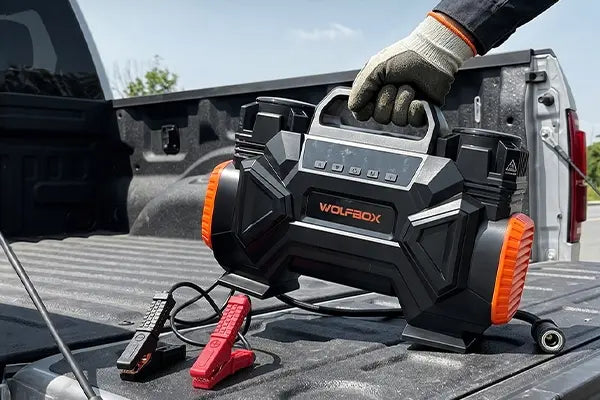
The Wolfbox MegaVolt 10Air pairs a 2000A peak jump starter with a 150 PSI air compressor. Its compact, lightweight body disappears into a saddlebag or under-seat storage. [1] [2]
For solo riders who don't want to worry about jump-starting anything other than a bike, it's more practical. The assumption here: the person carrying it cares more about weight and pocket space.

Specs That Matter for a Bike
- 2000A peak current from a 37Wh lithium battery, well above the 150 to 300 CCA a typical motorcycle actually needs.
- A 150 PSI air compressor for topping off motorcycle or scooter tires, which run different pressure ranges than car tires.
- A 200-lumen LED flashlight with SOS and strobe modes, useful for roadside visibility on a bike where hazard lights are less noticeable.
- Reverse-polarity protection and multiple built-in safety features to prevent damage from a rushed or incorrect connection.
Best For
- Solo riders who want the lightest, most compact option that still handles a real jump start.
- Anyone storing the unit directly on the bike, where every extra ounce and cubic inch matters.
- Riders who need motorcycle, scooter, or ATV coverage without a second vehicle to think about.
WOLFBOX MegaVolt 24: More Power for Multi-Vehicle Garages
The WOLFBOX MegaVolt 24 delivers 4000A peak current and is rated for gas and diesel engines up to 10.0L, as well as motorcycles. [3] [4]
Households with a truck, SUV, or diesel vehicle alongside a bike benefit from the single unit. It matters when you want to keep one well-charged unit in rotation.

Specs That Matter for a Bike
- 4000A peak current provides plenty of starting power for motorcycles as well as larger gas and diesel vehicles.
- IP64 & cold-resistant protection resists water and dust and withstands temperatures as low as -4°F, making it suitable for cold and challenging conditions.
- PD 65W I/O Fast Charge + 24,000 mAh Capacity provides substantial battery capacity while supporting fast charging for compatible devices.
- A 200+lumen flashlight with high beam, strobe, and SOS modes for roadside visibility at night.
Best For
- Riders who also own a truck, SUV, or diesel vehicle and want one jump starter that covers everything.
- Anyone who values extra battery capacity and jump-start count over the smallest possible size.
- Households where the jump starter lives in a truck or garage rather than strapped to the bike itself.
Scooters, ATVs, and Other Powersports Batteries
Scooters, ATVs, and personal watercraft follow the same small-battery rules as motorcycles. Most run 12V systems with batteries in a similar 4 to 20 amp-hour range. The main differences come down to battery terminal accessibility and how much vibration or weather exposure the unit needs to survive.
What Changes Across Powersports Vehicles
The core jump-starting process stays the same. Still, a few details shift depending on what you're riding.
- Scooters often tuck their battery under the seat or floorboard. It can make clamp access tighter than on a standard motorcycle.
- ATVs and side-by-sides usually feature a slightly larger battery than a street bike. However, it still sits well under a car's capacity.
- Personal watercraft batteries are frequently harder to reach. You may need to remove a seat or storage compartment first.
One Set of Rules, Several Vehicles
- As long as every vehicle in question runs a 12V system, the same portable jump starter can handle a motorcycle, scooter, ATV, and side-by-side.
- Confirm voltage and battery accessibility ahead of time. Doing so during an actual emergency will trigger real frustration.
- A single well-charged unit stored in a garage or truck can realistically back up an entire small fleet of powersports vehicles.
Jump-Starting a Motorcycle the Right Way
Jump-starting a motorcycle takes about three minutes once you know the correct order. Most of the risk comes from skipping a step. A calm, practiced routine beats a rushed one every time. AAA's jump-starting guidance emphasizes safety basics, like avoiding sparks near a battery. [9]
Step-by-Step
The sequence is nearly identical to jump-starting a car, just on a smaller scale.
- Confirm your bike's battery is 12V and check for visible damage, cracks, or swelling before connecting anything.
- Connect the red positive clamp to the battery's positive terminal. Then, connect the black negative clamp to an unpainted metal surface away from the battery, not the negative terminal directly.
- Turn on the jump starter's boost mode if it has one. Press the start button; most bikes turn over within a few seconds.
- Disconnect the clamps in reverse order once the engine is running. Let the bike idle for several minutes before shutting it off.
Mistakes That Cause Damage
Jump-starting from a running car instead of a battery or a portable unit, which risks an unregulated voltage spike. [5] [9]
- Reversing the polarity of the clamps, especially in low light or when rushing to get back on the road.
- Cranking the starter for too long in one attempt instead of pausing between tries, which can overheat the starter motor.
Storing a Jump Starter on a Bike, Scooter, or ATV
Motorcycles and scooters don't have a trunk or glove box. So, where and how you store a jump starter matters. A little attention to weatherproofing and charge habits keeps the unit ready. None of the habits take more than a few minutes.
Where to Stash It
- A saddlebag or top case protects the unit from road grime and vibration better than an open rack or bungee-corded pack.
- Wrapping the unit in a small dry bag adds extra protection against rain if your storage isn't fully sealed.
- Keep the jump starter's cables coiled and secured separately to prevent them from rattling loose over rough roads.
Keeping It Charged Between Rides
- Recharge the unit every month or two, even if you haven't used it, since lithium units slowly self-discharge over time.
- Check the charge level before any longer ride, especially at the start of riding season after winter storage.
- Keep the unit in a moderate temperature range when possible, since extreme heat or cold can temporarily reduce battery performance.
Conclusion
The best jump starter for motorcycle riders matches the quality and smart regulation to how and where you ride. The Wolfbox MegaVolt 10Air fits solo riders who want the smallest possible footprint. [1] Meanwhile, the Wolfbox MegaVolt 24 makes more sense for multi-vehicle households that need one unit to cover a bike and a truck alike. [3]
Either way, the small-battery rules stay the same. You must match the voltage, connect the clamps correctly, and trust that it's a quality jump starter. That's where Wolfbox delivers protected power to get your engine running again. [10]
Frequently Asked Questions (FAQs)
What is the best jump starter for a motorcycle?
A compact, portable lithium jump starter with reverse-polarity protection and smart current regulation is best. The Wolfbox MegaVolt 10Air works well for most riders. Households with a larger vehicle too may prefer the higher-capacity MegaVolt 24 instead.
Will a high-amp jump starter damage my motorcycle battery?
No. A quality jump starter only delivers the current your battery and starter motor draw. The real risk comes from jump-starting off a running car's alternator, not from a portable unit's peak-amp rating.
Can I jump-start a motorcycle with a car jump starter?
Yes, as long as the voltage matches (12V to 12V) and you follow correct polarity. Most portable car jump starters work fine on a motorcycle. First, confirm your bike isn't an older 6V system.
How many amps does a motorcycle actually need to start?
Most motorcycles need roughly 150 to 300 Cold Cranking Amps, far less than a car. Any modern portable jump starter rated 1000A or higher comfortably covers that requirement.
Where should I store a jump starter on a motorcycle?
A saddlebag, top case, or other enclosed storage protects it best from weather and vibration. Wrapping it in a small dry bag adds extra protection if your storage isn't fully sealed.
References
[1] Wolfbox: "Wolfbox MegaVolt 10Air" – https://wolfbox.com/products/wolfbox-2000a-jump-starter-with-air-compressor-wolfbox-megavolt-10air
[2] Wolfbox: "Wolfbox Jump Starter Review" – https://wolfbox.com/blogs/jump-starter-with-air-compressor/wolfbox-jump-starter
[3] Wolfbox: “Wolfbox MegaVolt24 Jump Starter” - https://wolfbox.com/products/wolfbox-megavolt24-jump-starter
[4] Men's Journal: "Wolfbox 4000Amp Jump Starter Gear Review" – https://www.mensjournal.com/gear/wolfbox-4000amp-jump-starter-gear-review
[5] Wolfbox: "Best Jump Starter for RV, Motorcycle, and Diesel Truck" – https://wolfbox.com/blogs/jump-starter/best-jump-starter-for-rv-motorcycle-diesel-truck
[6] Yuasa Battery: "Motorcycle Battery Jump Start Guide" – https://www.yuasabatteries.com/motorcycle-battery-jump-start-guide/
[7] Powpow Energy: "How Many Cranking Amps Does a Motorcycle Battery Have" – https://www.propowenergy.com/news/how-many-cranking-amps-does-a-motorcycle-battery-have/
[8] Motorcycle.com: "Ask MO Anything: Jumpstarting A Motorcycle From A Car" – https://www.motorcycle.com/features/ask-mo-anything-jumpstarting-a-motorcycle-from-a-car.html
[9] AAA: "How to Jumpstart a Car (and Keep Your Battery Healthy)" – https://mwg.aaa.com/via/car/how-to-safely-jumpstart-a-car
[10] Wolfbox: "Wolfbox Jump Starter" – https://wolfbox.com/collections/jump-starter-1

Leave a comment
All comments are moderated before being published.
This site is protected by hCaptcha and the hCaptcha Privacy Policy and Terms of Service apply.