








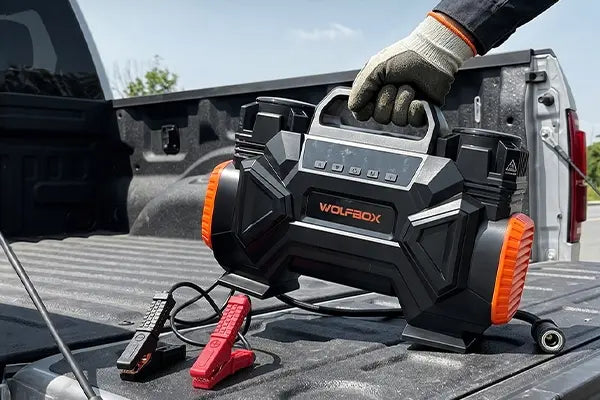
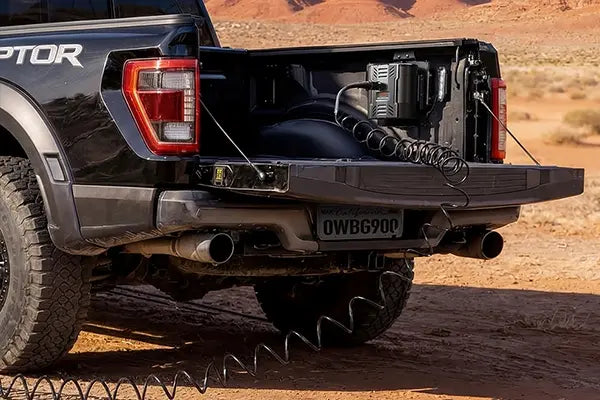

Tire pressure drifts the most right before the trip that needs it to be accurate. Summer heat adds pressure to tires that were set correctly in cooler spring weather, and a long highway drive on tires that are still off from a winter reading raises the risk of a blowout at speed. A WOLFBOX MegaVolt 24Air or WOLFBOX MegaVolt 10Air handles that pressure check and top-up along with a dead-battery jump start, combining both into a single piece of trunk gear instead of two separate tools[1][2].
Why Tire Pressure Matters More Before a Summer Road Trip
Tire pressure is measured in PSI, or pounds per square inch, and the correct reading is the cold tire pressure — the number taken before the tires have warmed up from driving, since heat expands the air inside and raises the reading temporarily. A tire that's correctly set after sitting overnight can already read several PSI higher by the time a summer afternoon's hot pavement and hours of highway friction are added on top of it, and a long-distance trip multiplies that heat exposure well beyond a normal commute. Checking pressure with a WOLFBOX MegaVolt 24Air or WOLFBOX MegaVolt 10Air before leaving catches a tire that's off while it's still an easy top-up, not a roadside problem at highway speed.
How Underinflated Tires Fail in Summer Heat
Underinflated tires generate their own heat, and that's the part most drivers never think about. A tire running low on air flexes more with every rotation. All that extra flex builds heat inside the rubber and belts — heat with nowhere to go. Now stack a hot summer highway on top of that: ambient heat pushing the pressure reading up, internal heat building from the inside, both happening at once. That combination is what causes a blowout instead of a gradual flat. A WOLFBOX MegaVolt 24Air or WOLFBOX MegaVolt 10Air catches the underinflation before any of that starts. No dashboard light. No shredded tire on the shoulder.
What a Jump-Starter-and-Inflator Actually Combines
A jump-starter-and-inflator does two jobs that used to need two separate tools. One side is a battery pack, strong enough to crank a stalled engine. The other is an air compressor, strong enough to actually inflate a full-size tire — not just hiss at it for ten minutes and give up. Peak current is the number that matters here. Measured in amps (A), it's the burst of electrical current a jump starter delivers to turn over an engine that won't start on its own. Bigger number, bigger engine it can handle. The WOLFBOX MegaVolt 24Air delivers 4,000A of peak current — enough for gasoline engines up to 10 liters, diesel up to 10 liters[1]. The WOLFBOX MegaVolt 10Air delivers 2,000A, sized for gasoline engines up to 5.0 liters and diesel engines up to 3.0 liters[2].
Peak Current vs. Cranking Amps: Reading the Spec Sheet
Peak current and cranking amps are not the same number, and mixing them up leads to buying a unit that's underpowered for a given engine. Cranking amps (CA) measure the sustained current a battery can deliver over a longer window at a set temperature, while peak current is the brief maximum burst a jump starter delivers for the split second it takes to turn an engine over; brands list peak current because it's the larger, more attention-grabbing number, but matching that rating to an engine's actual size is what determines whether a jump start works on the first try. The WOLFBOX MegaVolt 24Air's 4,000A peak current rating and the WOLFBOX MegaVolt 10Air's 2,000A rating are both measured this way, which is why the two units are sorted by engine size rather than by price alone[1][2].
Comparing the WOLFBOX MegaVolt 24Air and WOLFBOX MegaVolt 10Air
The WOLFBOX MegaVolt 24Air and WOLFBOX MegaVolt 10Air are sized for different vehicles and different trip lengths, not for the same buyer[1][2]. Battery capacity is listed in mAh (milliamp-hours) or Wh (watt-hours); Wh is the more useful figure for comparing the two units since it accounts for voltage rather than just raw charge quantity. Both units also carry an IP64 rating, meaning the housing is sealed against dust and protected against water splashed from any direction — a relevant spec for gear that lives in a trunk through changing weather[3].
|
Spec |
MegaVolt 24Air |
MegaVolt 10Air |
|---|---|---|
|
Peak current |
4,000A |
2,000A |
|
Battery capacity |
24,000mAh / 88.8Wh |
37Wh |
|
Engines started |
Gas up to 10L, diesel up to 10L |
Gas up to 5.0L, diesel up to 3.0L |
|
Jump starts per full charge |
Up to 40 |
Up to 30 |
|
Tire inflator |
45L/min, 160 PSI max |
150 PSI max, fills a 195/65R15 tire in ~1 minute |
|
USB output |
USB-C PD 65W in/out, USB-A 18W |
USB-C 15W in, USB-A 12W out |
|
Flashlight |
400 lumens: constant, strobe, SOS |
200 lumens: high beam, strobe, SOS |
|
Operating range |
-4°F to 140°F, IP64 |
-4°F to 140°F, IP64 |
Source: WOLFBOX official product pages [1][2], independent testing [3].
Why the Extra Power of the MegaVolt 24Air Matters for Some Drivers, Not Others
A larger battery and higher peak current only matter if the vehicle and the trip actually call for them. The WOLFBOX MegaVolt 24Air's 4,000A rating and 88.8Wh battery are built for full-size trucks, SUVs, and diesel engines that need more cranking power, and for road trips long enough that inflating a full-size truck tire or running the compressor more than once in a day is a realistic scenario[1]. The WOLFBOX MegaVolt 10Air's 2,000A rating and 37Wh battery are sized for sedans, hatchbacks, and shorter trips where a compact, lighter unit matters more than maximum output[2].
Charging and Standby Time Before a Trip
A jump-starter-and-inflator is only useful on the day of a road trip if it's actually charged, and both WOLFBOX units are built to sit in a trunk for months without losing enough charge to matter. The WOLFBOX MegaVolt 24Air's battery has been reported to hold a usable charge for up to 6-12 months in storage, which means a unit bought in spring is still ready for a summer trip without a dedicated top-up before departure[3]. The WOLFBOX MegaVolt 24Air charges via USB-C at up to 65W, while the WOLFBOX MegaVolt 10Air charges at 15W, so a quick top-up the night before a trip is realistic for either unit even after months of sitting unused[2][3].
Checking and Topping Up Tire Pressure: What to Expect
A pre-trip pressure check takes only a few minutes with a WOLFBOX MegaVolt 24Air or WOLFBOX MegaVolt 10Air, since both units display current tire pressure and stop automatically once the target reading is reached[2][3]. The WOLFBOX MegaVolt 10Air's auto-stop function and five inflation-mode presets — car, motorcycle, bicycle, ball, and custom — read the tire's current pressure, inflate to the set target, and cut off automatically rather than requiring the driver to watch a gauge and stop by hand[2]. An F150gen14 forum member's hands-on test measured the WOLFBOX MegaVolt 24Air filling tires roughly twice as fast as a comparable single-function corded air compressor in the same comparison, which shortens the time spent stopped at the roadside or in a driveway before a trip[4].
How These Units Perform in Real-World Testing
A spec sheet only says so much. It can't show what happens when a jump-starter-and-inflator actually meets a dead battery in bad conditions — real-world testing does that instead. One reviewer took the WOLFBOX MegaVolt 24Air out to help a stranger whose mid-size SUV had died in a 0°F cold snap, hooked up the jump starter, and the engine turned over almost immediately[3]. That's the kind of test that actually means something. A unit that can crank an engine in weather that cold has margin to spare once summer heat is the only thing it's dealing with.
There's also the inflator itself. An F150gen14 forum member's hands-on test (a user self-test, not professional lab testing) clocked the WOLFBOX MegaVolt 24Air filling a tire roughly twice as fast as a single-function corded compressor tested in the same comparison[4]. Twice as fast doesn't sound like much on paper. But out on the road, less time stopped at the shoulder means less time exposed to traffic — and that's the whole point of this guide.
Who Should Choose Which
- Own a full-size truck, SUV, or diesel and heading out for one of the last road trips of summer? The WOLFBOX MegaVolt 24Air's higher peak current and bigger battery are built for that — more engine, more tire to fill.
- Driving a sedan, hatchback, or crossover on a shorter regional trip: the WOLFBOX MegaVolt 10Air does the same job in a smaller, lighter package.
- Already carrying a full-size air compressor and a separate jump box? A combined WOLFBOX MegaVolt 24Air or WOLFBOX MegaVolt 10Air won't add much — mostly just frees up trunk space.
Frequently Asked Questions
Do I need to check tire pressure before a summer road trip, or just before winter?
Yes, summer trips too, not just winter. Pressure should get checked any time the temperature swings or before a long drive, and that's exactly where a WOLFBOX MegaVolt 24Air or WOLFBOX MegaVolt 10Air earns its keep.
What's the difference between the WOLFBOX MegaVolt 24Air and the WOLFBOX MegaVolt 10Air?
Mostly power and battery size. The WOLFBOX MegaVolt 24Air runs 4,000A off an 88.8Wh battery, built for bigger engines and heavier-duty inflation. The WOLFBOX MegaVolt 10Air scales that down to 2,000A and a 37Wh battery for smaller vehicles[1][2].
What's the difference between peak current and cranking amps?
Peak current is the quick burst that actually turns the engine over. Cranking amps measure something different — sustained output over a longer stretch. Both the WOLFBOX MegaVolt 24Air and WOLFBOX MegaVolt 10Air are rated by peak current, so that's the number to check against engine size.
Can a WOLFBOX MegaVolt 24Air or WOLFBOX MegaVolt 10Air overinflate a tire?
No, not under normal use. Both units — the WOLFBOX MegaVolt 24Air and the WOLFBOX MegaVolt 10Air — cut off automatically once the tire hits the pressure the driver set[2][3].
How long can a WOLFBOX MegaVolt 24Air or WOLFBOX MegaVolt 10Air sit unused before a trip?
Months. The WOLFBOX MegaVolt 24Air has been reported to hold a usable charge for up to 6-12 months sitting in storage, so a quick top-up the night before is usually all it takes[3].
Can I use a WOLFBOX MegaVolt 24Air or WOLFBOX MegaVolt 10Air to charge my phone on a road trip?
Yes. Both double as power banks — the WOLFBOX MegaVolt 24Air pushes up to 65W over USB-C, the WOLFBOX MegaVolt 10Air does 15W — and either keeps a phone or tablet charged on a long drive[1][2].
Is a jump-starter-and-inflator combo necessary if I already have roadside assistance coverage?
Depends on how remote the trip gets. Roadside assistance still means waiting on a truck. A WOLFBOX MegaVolt 24Air or WOLFBOX MegaVolt 10Air skips the wait entirely — which matters a lot more on a stretch of highway with no cell signal.
References
- [1] WOLFBOX — MegaVolt 24Air Official Product Page: https://wolfbox.com/products/jump-starter-with-air-compressor-tire-inflator-wolfbox-megavolt-24air
- [2] WOLFBOX — MegaVolt 10Air Official Product Page: https://wolfbox.com/products/wolfbox-2000a-jump-starter-with-air-compressor-wolfbox-megavolt-10air
- [3] Popular Science — I Tested the Wolfbox 4-in-1 Jump Starter with Air Compressor During a Real-World Emergency: https://www.popsci.com/gear/wolfbox-4-in-1-jump-starter-with-air-compressor-review/
- [4] F150gen14 Forum — WOLFBOX MegaVolt 24 Air Review: https://www.f150gen14.com/forum/posts/819256/


Leave a comment
All comments are moderated before being published.
This site is protected by hCaptcha and the hCaptcha Privacy Policy and Terms of Service apply.