
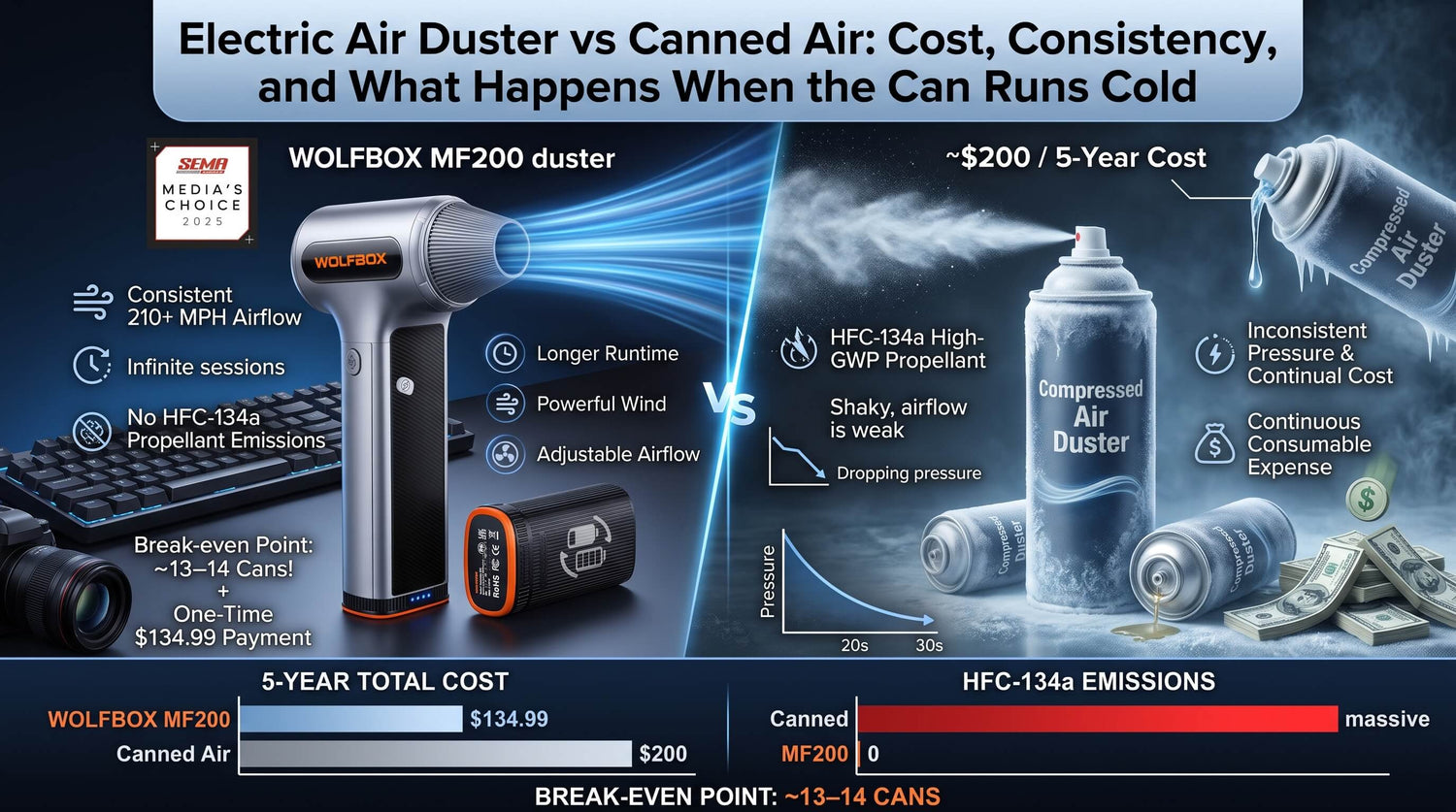
Four cans of compressed air per year at ten dollars each: forty dollars annually, two hundred dollars over five years. Along the way, twenty cans of HFC-134a propellant — a greenhouse gas with a global warming potential 1,430 times that of CO2 over 100 years.1 The WOLFBOX MF200 electric air duster costs $134.99 once and requires no consumables afterward.3 The break-even point against canned air is approximately 13–14 cans. After that, every cleaning session costs nothing. This guide explains the full cost picture, the performance differences in actual use, and where canned air still makes sense.
Five-Year Cost and Emissions Comparison
Metric |
Canned Air (4 cans/year @ $10) |
WOLFBOX MF200 |
Year 1 cost |
~$40 |
$134.99 one-time |
Years 2–5 annual cost |
~$40/year |
$0 |
5-year total |
~$200 |
~$134.99 |
HFC-134a released over 5 years |
approximately 5.4 kg |
0 kg |
Break-even point |
N/A |
~13–14 cans |
What HFC-134a Is and Why It Matters
Most canned air dusters marketed for electronics use HFC-134a (R-134a) as the propellant. HFC-134a is a hydrofluorocarbon with a 100-year global warming potential (GWP) of 1,430, per the IPCC Fourth Assessment Report — meaning each kilogram released has 1,430 times the atmospheric warming impact of CO2.1 The EU has phased it out under the F-Gas Regulation. In the US, the California Air Resources Board classifies gases above GWP 150 as high-GWP substances requiring management reporting.2
The environmental case for switching is not abstract. A single standard 10 oz can of compressed air releases approximately 270 grams of propellant when fully used. At 1,430 GWP, that's the equivalent of roughly 386 kg of CO2 per can. Most users don't finish each can before buying the next one. The actual propellant released per can purchased is often higher than full-use math suggests.
The Pressure Drop Problem with Canned Air
A can of compressed air loses pressure as the liquid propellant depletes and as the can chills from the pressure drop inside — this happens within the first 30 seconds of continuous use. You've probably noticed the airflow weakening mid-session and had to wait for the can to warm up. The MF200 delivers consistent airflow at its rated setting throughout the session, regardless of runtime or ambient temperature.3
The second physical issue is orientation. Using a canned air duster inverted or tilted past a certain angle releases the liquid propellant rather than the gas. That liquid contacts the surface directly — and on electronics, it can cause thermal shock or leave residue. The MF200 has no liquid component and can be used at any angle without this risk.5
WOLFBOX MF200 Specs and What They Mean in Practice
- Airflow: 210+ MPH (93.9 m/s) at maximum speed, three adjustable settings3
- Motor: 110,000 RPM turbo fan — no filtration media in the airstream
- Battery: 6,000 mAh removable lithium-ion, charges via USB-C in approximately 2.5 hours3
- Two batteries included: combined runtime approximately 40–60 minutes before any recharging
- Hot-swap battery: swap takes approximately 5 seconds
- Four nozzle attachments included for directed airflow
- Weight: 0.84 lb
- Warranty: 30 months3
GearDiary reviewed the MF200 and confirmed the airflow speed, 2.5-hour charge time, and swappable battery system, calling the battery design "the standout feature for extended cleaning sessions."4
Airflow by Task: Matching Speed to Application
Task |
Speed Setting |
Distance and Notes |
Camera lens (external surface) |
Low |
6+ inches; avoid close contact |
Keyboard switches and keycaps |
Medium |
2–4 inches; angle to push debris laterally |
PC heatsink and GPU fans |
Medium–High |
3–6 inches; hold fans stationary |
Car interior vents |
Medium |
3–4 inches from vent opening |
3D printer nozzle and extruder |
Medium |
Tangential angle to mechanism |
When Canned Air Still Makes Sense
Electric air dusters are not the right tool in every situation. Canned air still makes sense for: a one-time emergency when no charged electric duster is available; extremely weight-constrained travel where carrying any charging accessory is not practical; and contamination-controlled professional environments that require single-use sealed cans. For anyone who cleans electronics or photography gear more than two to three times per year, the math strongly favors the electric duster from the third purchase onward.
Frequently Asked Questions
Q: What propellant is in most canned air dusters?
A: Most canned air dusters for electronics use HFC-134a (R-134a). HFC-134a has a global warming potential of 1,430 over 100 years per IPCC AR4 — each kilogram released equals 1,430 kg of CO2 in atmospheric warming impact. The EU has phased it out under the F-Gas Regulation. California classifies it as high-GWP requiring reporting.
Q: How quickly does the WOLFBOX MF200 pay for itself vs canned air?
A: At $10 per can, the MF200's $134.99 cost pays back after approximately 13–14 cans purchased. However, since the MF200 replaces all ongoing canned air purchases, regular users break even after 3–4 cleaning sessions. Over five years, canned air at 4 cans/year costs approximately $200 vs $134.99 total for the MF200.
Q: What is the WOLFBOX MF200 maximum airflow speed?
A: The WOLFBOX MF200 delivers 210+ MPH (93.9 m/s) at maximum speed via its 110,000 RPM turbo fan. Three adjustable speed settings allow you to match airflow to the task.
Q: Is the WOLFBOX MF200 battery swappable mid-session?
A: Yes. The 6,000 mAh battery removes and swaps in approximately 5 seconds. Two batteries are included, providing approximately 40–60 minutes combined runtime before any recharging is needed. Each battery charges via USB-C in approximately 2.5 hours.
Q: Why should I not use canned air upside down?
A: Inverting canned air releases liquid propellant instead of gas. That liquid can cause thermal shock on electronics or leave residue on sensitive surfaces. Electric air dusters have no liquid component and can be used at any angle safely.
Q: Does the WOLFBOX MF200 filter the air it blows out?
A: No. The MF200 draws in ambient air and drives it out via the turbo fan motor without a filtration layer. It displaces dust with directed airflow — it is not a filtration device and should not be used in applications requiring filtered or sterile airflow.
Q: How long does the MF200 battery last per charge?
A: Approximately 20–30 minutes per charge depending on speed setting. At medium speed, most single cleaning sessions finish within one charge. The included second battery covers extended sessions without waiting.
References
1. Australian DCCEEW – GWP Values for HFC Refrigerants (IPCC AR4 source): https://www.dcceew.gov.au/environment/protection/ozone/rac/global-warming-potential-values-hfc-refrigerants
2. California Air Resources Board – High-GWP Refrigerants: https://ww2.arb.ca.gov/resources/documents/high-gwp-refrigerants
3. WOLFBOX MF200 Official Product Page (US): https://wolfbox.com/products/compressed-air-duster-mf200
4. GearDiary – WOLFBOX MF200 Compressed Air Duster Review: https://geardiary.com/2025/11/10/wolfbox-mf200-review/
5. WOLFBOX Blog – Wolfbox Air Duster Review: https://wolfbox.com/blogs/air-duster/wolfbox-air-duster-review
6. WOLFBOX MF200 EU Product Page: https://eu.wolfbox.com/products/wolfbox-mf200-compressed-air-duster-swappable-battery-cartridge
7. Newegg – WOLFBOX MF200 Electric Air Duster: https://www.newegg.com/p/0G8-010F-00003
- WOLFBOX MF200 Electric Air Duster Official Product Page: https://wolfbox.com/products/compressed-air-duster-mf200
9. WOLFBOX Blog – Best Air Duster for Electronics, 3D Printers and Camera Lenses: https://wolfbox.com/blogs/air-duster/best-air-duster-for-electronics-3d-printers-camera-lenses
10. WOLFBOX About Us: https://wolfbox.com/pages/about-us



Leave a comment
All comments are moderated before being published.
This site is protected by hCaptcha and the hCaptcha Privacy Policy and Terms of Service apply.