







WOLFBOX Brands
WOLFBOX Brands
If you have ever tried to review footage after a minor fender bender, only to find the camera caught the sky instead of the license plate in front of you, you already know how important proper angle setup is. Getting your dash cam angle right is not just a one time thing you do when you unbox the camera. It requires a bit of thinking, but it really pays off in the end when it comes to your actual footage.
In this article, you'll be able to learn all the important tips on making sure that you are getting the most out of your dash cam’s viewing angle – how to choose a good quality lens and set up your camera properly.
Most drivers buy a dash cam and stick it somewhere on the windshield without much thought. The result? Footage that captures too much sky, too little road, or completely misses the side action. According to the National Highway Traffic Safety Administration (NHTSA), driver assistance and recording devices are only as useful as their field of view. A poorly positioned camera essentially becomes useless evidence in an accident claim.
The goal is simple: capture as much of the road and surroundings as possible, in sharp detail, without distorting the image so much that number plates become unreadable.
When you shop for a camera, you will see specs like 140 degrees, 150 degrees, or even 170 degrees. Here is what those numbers actually mean for your real world coverage:
Field of View (FOV) |
Coverage level |
Best for |
Trade off |
90 to 110 degrees |
Narrow |
Highway driving, focused front capture |
Misses side lanes entirely |
120 to 140 degrees |
Moderate |
Most daily commuters |
Some edge distortion |
150 to 160 degrees |
Wide |
Urban driving, intersections |
Slight fisheye effect |
170+ degrees |
Ultra wide |
Parking lots, taxis, rideshare |
Heavy distortion at edges |
A wider angle of view does not always mean better footage. The sweet spot for most drivers falls between 140 and 160 degrees, where you get broad coverage without too much distortion making license plates hard to read at a distance.
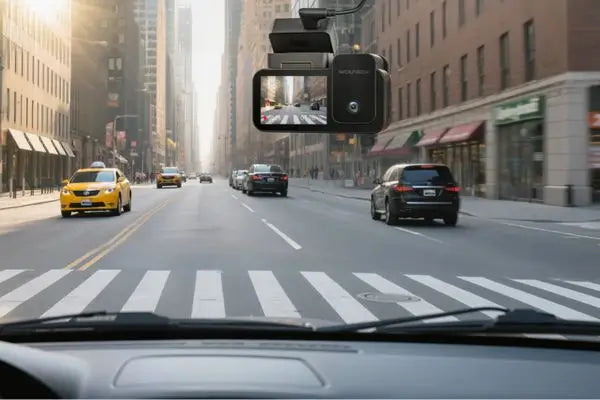
A wide angle dash cam is really helpful when you are driving in the city. This is because things can happen from all sides at the same time.
For example, think about intersections. When you are merging into another lane or when you are driving in a parking lot, you might get into a scrape with another car.
The extra view that you get from a wide angle dash cam is very useful because it can see cars coming from the sides, it can see people walking across the road, and it can even see things that're in the lanes next to you. If the angle is too wide, it can cause problems. The main problem is something called barrel distortion.
This is when straight lines look curved at the edges of the picture. This can make it hard to read the license plates on cars that're not directly in front of you. The best wide angle dash cams have coatings on the lens, and they have advanced image processing. These things help to fix the distortion problem, so you can still see a lot of what's happening around you and you can still read the license plates clearly. The best wide angle dash cam models are very good at doing this. They can give you an angled view, without the distortion, which is very useful when you are driving in the city with a wide angle dash cam.
Mount the camera behind the rearview mirror so the camera does not block your line of sight
Angle the lens so roughly two-thirds of the frame shows the road and one-third shows the horizon or sky
Avoid pointing it too high or the camera will capture more hood and sky than the actual road ahead
Keep the lens free of any tint lines on the windshield, which can interfere with footage quality
Mount near the top center of the rear windshield for the widest unobstructed view
Tilt the lens slightly downward to capture cars approaching from behind
Avoid mounting too low, which puts your own bumper in the shot and reduces usable view
If you have a dash cam front and rear setup, make sure both cameras are angled consistently so the footage makes sense when reviewed together
Position to capture the driver and passenger area without cutting off too much of the front view
Useful for rideshare drivers or commercial vehicles
Make sure it does not interfere with airbag deployment paths
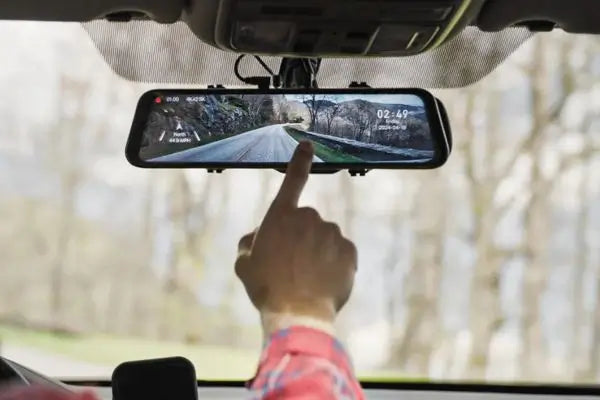
If you want wide coverage without any additional hardware cluttering your windshield, mirror dash cams are worth a serious look. These replace or overlay your existing rearview mirror, giving you a clean, integrated look while offering a wide front view and a rear camera feed all in one screen. The mirror form factor also means the camera sits in an optimal position by design, reducing the guesswork that comes with traditional windshield mounts.
Mistake |
What happens |
How to fix it |
Too much sky in frame |
Road details are cut off at the bottom |
Tilt the camera slightly downward |
Dashboard reflection |
Glare washes out the image |
Use a polarizing filter or adjust the mounting spot |
Camera blocked by tint strip |
Footage appears blurry or discolored at the top |
Mount below the tint strip |
Rear camera angled too high |
Misses approaching vehicles until they are very close |
Tilt down to show more of the road behind |
Side lanes invisible |
Incidents from adjacent lanes not captured |
Upgrade to a wide angle dash cam with 150-plus degrees FOV |
Not all cameras handle wide angles equally. Resolution, sensor size, and lens quality all play a role in whether that 160 degree field of view translates into usable footage or just a blurry, distorted mess. When browsing the dash cams available, pay attention to these key specs alongside the advertised field of view:
Resolution: 1080p is the minimum, but 1440p or 4K makes a real difference for reading plates
Night vision: Sony STARVIS or similar sensors handle low light dramatically better
Lens aperture: A wider aperture (lower f number) lets in more light for cleaner footage
Loop recording: Essential for uninterrupted use without manual file management
Parking mode: Detects motion or impacts when the car is parked
Quality Wolfbox dash cams combine these specs with reliable wide angle coverage that has been tested in real driving conditions, making it a practical choice for drivers who want footage they can actually use.
For city driving, a field of view between 140 and 160 degrees is usually the best option. This range provides solid coverage of intersections and adjacent lanes without adding too much distortion, so license plates can still remain readable. A dash cam with an angle in this range is a strong choice for daily urban driving.
Review a short clip after mounting and check that roughly two thirds of the frame shows road ahead and one third shows the horizon or sky. You should be able to clearly read the license plate of a vehicle about 10 meters in front of you. If the plate is blurry or the road is barely visible, adjust the tilt up or down accordingly.
Not always. If the angle is too wide, like more than 170 degrees, it can make the picture look funny, and it can be hard to see what is going on. The best angle for people is between 140 and 160 degrees because it shows a lot of the road without making the picture too distorted at the edges.
A single front camera does not cover what happens behind your vehicle, which is actually where many accidents occur, especially rear-end collisions. A front and rear setup is strongly recommended for complete protection. If you want a clean, clutter-free install, a mirror dash cam gives you both views without adding extra hardware to your windshield.
